


Dr. Bronner’s “All-One Activist” series profiles influential activists who are advancing the core causes that Dr. Bronner’s supports through its philanthropy and advocacy.
As part of our ongoing All-One Activist series, we are highlighting the organizations supported through the All-One Canada Initiative, the Canadian chapter of Dr. Bronner’s All-One International Initiative. Through this initiative, at a minimum, 1% of sales from participating international markets is donated annually to support local efforts focused on social justice, environmental sustainability, and animal advocacy.
Funding for climate justice movements reveals a stark and urgent truth. While the world rallies behind well-known environmental organizations and mainstream advocacy efforts, less than 1% of global philanthropy reaches Indigenous peoples. This imbalance has devastating consequences. It means fewer Indigenous-led organizations, fewer community-driven solutions, and far fewer opportunities for Indigenous nations to defend their lands, their rights, and their futures.
The gravity of this crisis is deeply understood by Eriel Tchekwie Deranger, co-founder of Indigenous Climate Action, the only Indigenous-led climate justice organization in Canada. Eriel has witnessed firsthand how chronically underfunded Indigenous communities are expected to confront the accelerating climate emergency with a fraction of the support given to larger, non-Indigenous organizations.
The work of Indigenous Climate Action demonstrates the transformative power of what Indigenous peoples can achieve when they have the resources and authority they have long been denied. The organization does not seek merely to occupy a seat at the colonial climate justice table. They are building a new model of climate leadership rooted in Indigenous knowledge and sovereignty.
Since 2020, Dr. Bronner’s has supported Indigenous Climate Action through our All-One Canada Initiative. Dr. Bronner’s was honored to interview Eriel Tchekwie Deranger, who was selected for the Climate Breakthrough Award program in 2024 and recently transitioned from ICA’s executive director to president.
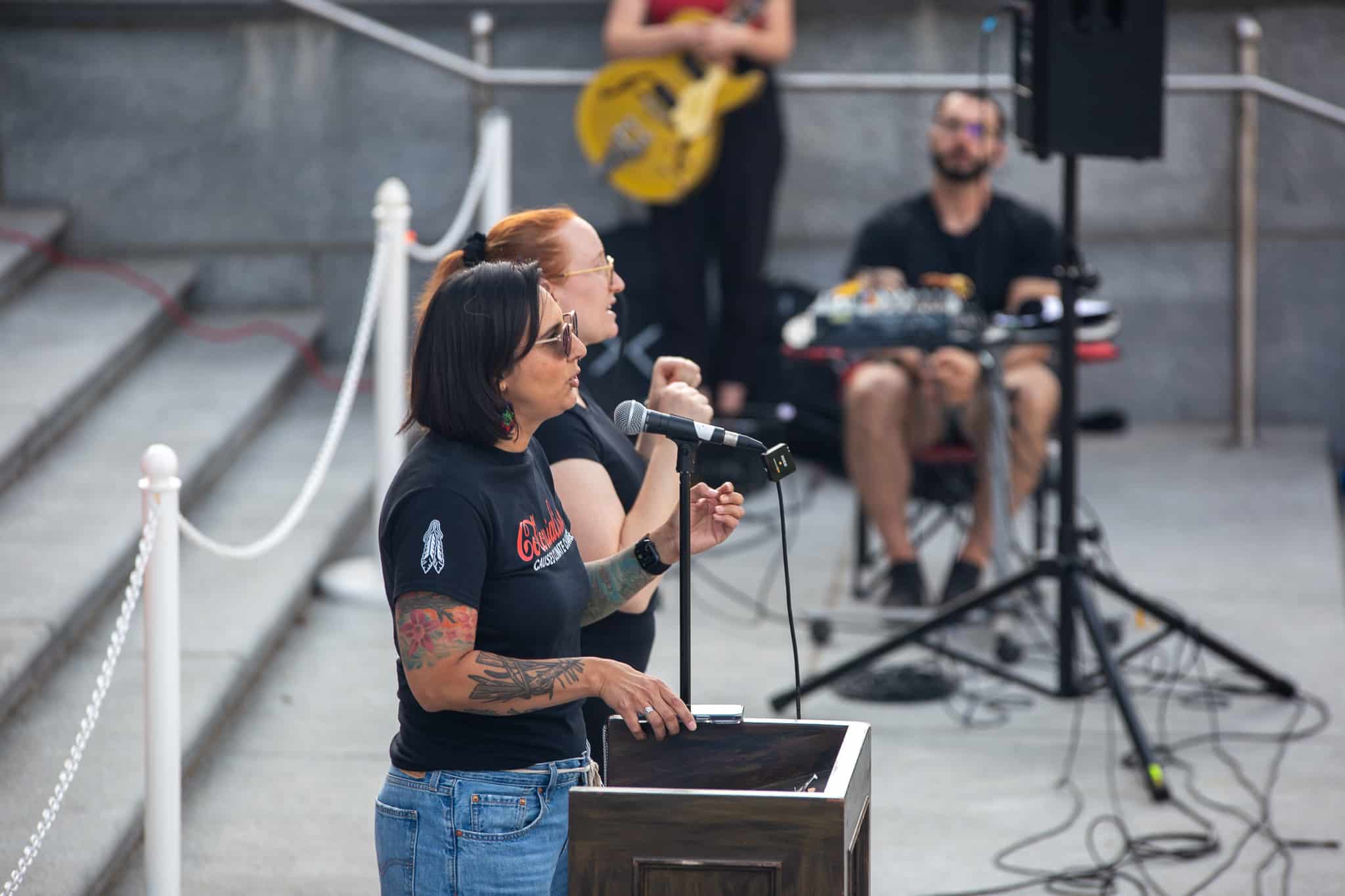
What is the work that Indigenous Climate Action does, why is it needed, and what should people understand about the impact you’re striving to make?
Indigenous Climate Action (ICA) is a movement-serving organization that leans into the power of our communities and our ancestral knowledge to reframe climate solutions with justice at the center. We support a thriving movement of Indigenous climate leaders by nurturing existing capacities of our communities, while also disrupting harmful systems of oppression, creating space for creativity to flourish for a new future that is just and sustainable. This looks like facilitating Indigenous spaces for knowledge exchanges on and offline; creating resources for and by Indigenous peoples through research and reports; supporting changing narrative strategies from community by providing education and training opportunities, access to our media platforms and supporting new media opportunities; and of course supporting our community members to speak for themselves and advancing sovereignty and self-determination through awards and honorariums to support those on the frontlines.
At ICA we see colonialism and capitalism as the root causes for rising greenhouse gas emissions and destabilized ecosystems that have ushered in the climate crisis. Colonial systems that have seen “man’s dominion over nature” as a right have justified industrialization and extractivism to fuel capitalist empires that have deemed others as less than. As Indigenous peoples, this is counterintuitive to our values of interconnectedness and interdependence with the living world. Indigenous cosmology and ideologies are rooted in these values and shape everything from our languages, cultural practices, and most importantly, our responsibilities to the living world as a whole. Instead of dominion over, Indigenous peoples are guided by values of responsibility with and not over. All living things are our kin.
By holding Indigenous peoples’ rights, culture, and ways of being at the center of climate justice, we open ourselves to possibilities outside of the limited and reduced frame of colonial systems and processes.
Describe the founding of Indigenous Climate Action, how you came to be involved, and the evolution of your work.
I grew up in a very active Indigenous rights activist community and household, and advocating for Indigenous rights has always been a part of my life. I found myself gravitating toward this type of work at a very young age but never envisioned myself as a founder of an organization. As a young adult, I found myself working as an archival and oral history researcher for the Federation of Sovereign Indigenous Nations (formally Federation of Saskatchewan Indian Nations) on Treaty Land Entitlement and Specific Land Claims. This would be a major catalyst for my work and paved the way for curiosity about how modern appropriations and misuse and abuse of Indigenous lands and territories were rampant in so-called Canada. I quickly saw the correlations between the environmental and climate movements and the movement for Indigenous rights and sovereignty.
At the time, I don’t think I was aware of just how personal this would become. By my late twenties, I was working with my own family in challenging the expansion of the Alberta Tar Sands, highlighting the human, interspecies, and environmental atrocities happening in my homelands. I worked alongside many large and well-known environmental non-governmental organizations (NGOs) that helped to bring our stories to the forefront, but I felt like something was missing. While these organizations all have good intentions at the heart of their advocacy for environmental and climate issues, many of them were built on colonial and often white supremacist values that saw themselves as saviors and Indigenous peoples as victims. I continued to see doors opening and invitations extended to more Indigenous peoples to the tables of these discussions, but few resources were available for Indigenous communities to build our own institutions to support our movements. More importantly, most of our people don’t want to be saved just to become part of the systems that robbed us of our dignity, our lands, and our children. For many of these allied groups, they were learning more from our stories and building stronger platforms, while the circumstances of our communities didn’t change, and this was something that I couldn’t stand idly by and witness. It needed to be changed. Our people are powerful, and constantly spending time “teaching” others was only part of the work; we needed something that allowed our strengths and creativity to be nourished.
ICA is born. I spent the better part of 2014 and 2015 reaching out to other environmental and climate activists to hear their own stories and ideas and ultimately learn about their love for their people and their lands. These dialogues led to the foundations of ICA, an Indigenous-led climate justice organization dedicated to Indigenous peoples and spurred the inaugural gathering of Indigenous climate leaders in Amiskwaciy Waskahikan (Edmonton), Treaty 6 (Alberta) in January of 2016. At this gathering, over 150 Indigenous peoples from across Turtle Island (North America) came together to discuss the climate crisis, Indigenous rights, current climate movements, and how we could strengthen the Indigenous peoples’ climate movement in so-called Canada. The outcomes of this gathering birthed the development of a National Steering Committee, which continues to guide ICA’s work and the foundations of the work this budding organization would do: gatherings for and by Indigenous peoples; amplifying our voices through multimedia platforms; education, training, and resources for and by Indigenous peoples; and supporting the sovereignty and self-determination of our communities.
We work alongside and with dozens of Indigenous organizations and groups to strategize ways to build a strong Indigenous movement of climate leaders. Our programs have grown from ideas seeded by the contributors at our inaugural gathering, our National Steering Committee, and surveys. We now foster the following successful programs:
- A multi-media narrative strategy that includes short videos, podcasts, webinars, social media campaigns, and online forums to support our community of Indigenous leaders with nearly 200,000 followers across our platforms.
- A youth leadership program that has created zines that highlight their stories.
- A Climate Leadership Program that has trained nearly 300 Indigenous people to reimagine the drivers of the climate crisis to be colonialism, and the solutions to live in our knowledge, ways of being, and advancing our rights as defined in the UN Declaration on the Rights of Indigenous Peoples (UNDRIP), treaty, and our own governance systems.
- Dozens of community-driven, downloadable reports and papers that highlight why Indigenous climate leadership is critical to shaping a just future and how current systems continue to fall short.
- Dozens of gatherings in communities, in cities, and online to share our knowledge, our strategies and change narratives from our people as victims to people of immense power.
- An international Indigenous climate engagement strategy to support understanding and learning from global Indigenous climate movements at the UNFCCC gatherings and meetings.
- Redistribution of hundreds of thousands of dollars to community members on the frontlines of climate justice through our Sovereignty In Action awards, youth honorariums, and community solidarity giving programs.
The work at ICA exemplifies the power of what Indigenous peoples can and will do when given adequate resources and power to do so. We don’t require a seat at the table, we require resources to build our own tables and sit side by side with our brothers and sisters to build a future that includes all systems, not a homogenous system that is disconnected from the natural world.
What are some of the biggest challenges you face, and how does Indigenous Climate Action work to overcome them?
Society at large lacks the ability to imagine a world that exists outside of colonial systems, and the faith that resourcing this work is valuable and has a tangible impact. Less than 1% of global philanthropy goes to Indigenous peoples. Many donors and philanthropic foundations don’t have relationships with frontline Indigenous communities, as they have historically and systematically been excluded from these spaces for generations, thus lending to a lack of understanding of Indigenous theory of change or avenues for implementing Indigenous rights solutions.
We are our own experts, and we should be trusted and treated as such. Our peoples had thriving and sophisticated systems of commerce, governance, education, and technologies prior to colonization that were developed from our ancient intergenerational knowledge. It’s time to expand our imaginations and invest in Indigenous peoples, our rights, and our solutions.
How do you choose which issues to prioritize, and what are some of the key issues you are currently focusing on (for example, a rights-based framework to divestment)?
We work with the community. By working with a National Steering Committee composed of diverse Indigenous peoples and engaging with our community partners, we are able to identify what is important now. Currently, we have been focusing on a two-fold strategy, nurturing the capacities of our communities through education and training, and disrupting harmful systems that have caused the climate crisis. In our work on reframing the divestment movement from project or industry-specific campaigns that are rooted in carbon accounting, we are leaning into an Indigenous rights-based approach to divestment that looks at the whole sector. By advocating for Indigenous rights-based reforms in the financial sector we could transform financial investment practices to implement higher human and Indigenous rights standards that could ultimately cease funding to projects that violate these standards. This wouldn’t just be one sector but could impact the entire industry. Additionally, it will force society at large into spaces of reimagining a world that is more holistic and just for all.
This is the power of Indigenous rights-based approaches to climate justice. It’s not just to save and advance our rights, but to support the health and well-being of the entire planet.
How do you collaborate with other Indigenous organizations globally to influence climate policy across borders?
Our work to expand into the global community deeply influences how we work nationally. For over five years, ICA has been participating in the UN Forum Convention on Climate Change (UNFCCC) Conference of the Parties (COP) gatherings to meet with, and learn from, the global Indigenous peoples’ climate movement. The International Indigenous Peoples Forum on Climate Change (IIPFCC), or the Indigenous Caucus, has been a tremendously important space to work and learn in. The IIPFCC convenes quarterly calls, preparatory meetings, and daily meetings during the COP gatherings to support a broader understanding of global Indigenous rights and climate policies, challenges, victories, and opportunities. Everything from the policies that drive the Paris Agreement, to global discussion on Just Transition, Loss & Damage, Climate Financing, proposed solutions, and everything in between happens in these spaces. By staying involved and actively participating in these spaces, we can provide regional communities with the best available information to support the practice of true Free, Prior and Informed Consent (FPIC), a founding tenet of the UNDRIP.
These spaces are Indigenous-led, like ICA, and provide an opportunity for us to practice true sovereignty and self-determination with a global perspective.
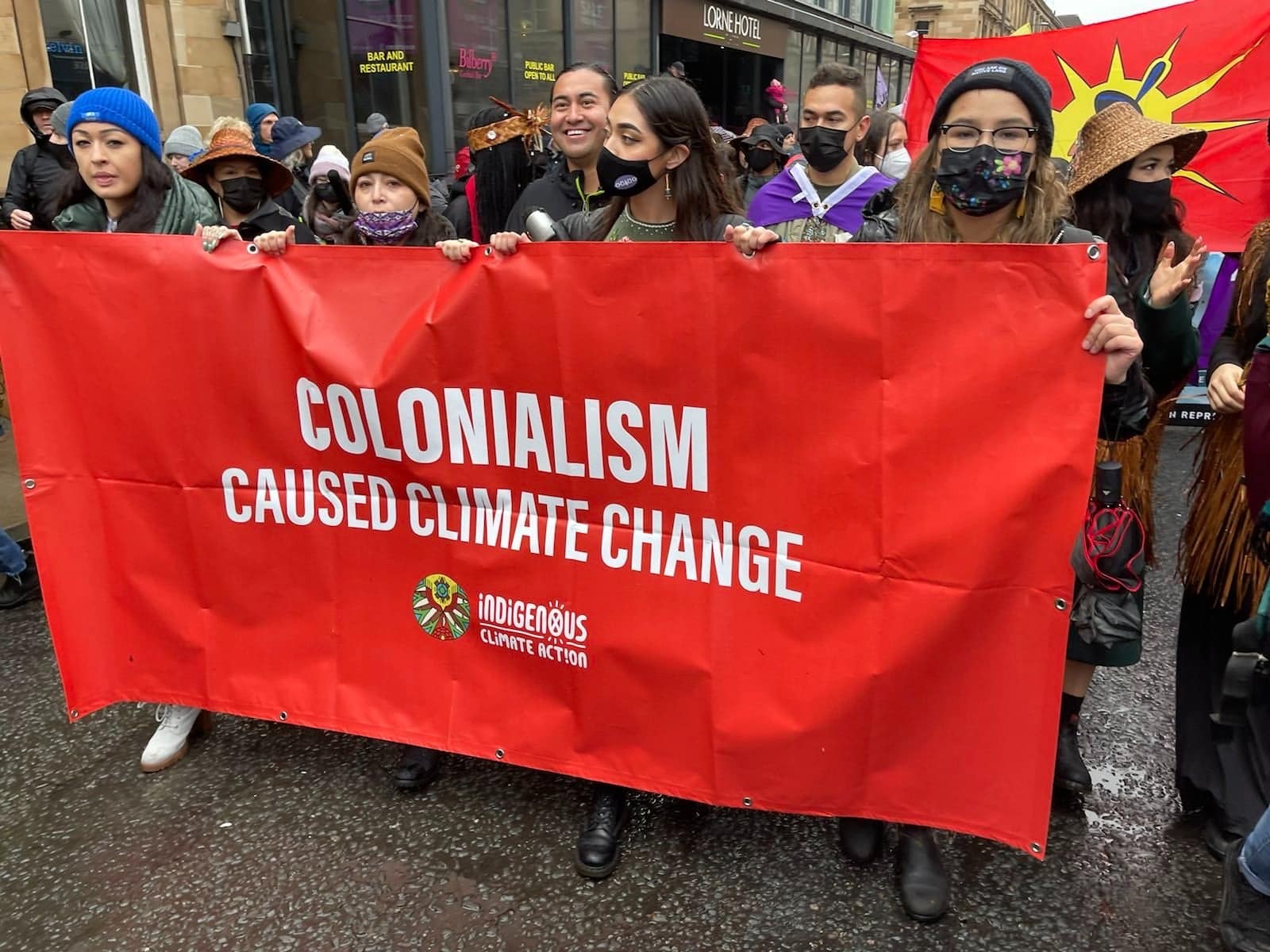
What are the movements or organizations that you find inspiring or promising at the moment, and how does Indigenous Climate Action help to support work being driven by other organizations?
It’s been happening for decades, or centuries, depending how you look at it, but the movement or the story that returns us to the land is always energizing and uplifting – it places us in the steps of those who came before us, who carried responsibility with joy – nowadays there are two different names to this, Land Back and Land Based Learning. ICA works towards both in everything we do, and we support community, community members, groups, and organizations from nations across Turtle Island. We do our best to make sure it is understood that Indigenous ways of being, learning, and the desire to regain what is lost are not just beneficial to our own well-being and healing but are imperative in any meaningful climate justice work. We support through partnerships, coalition building, petitions, amplification, sponsorships, programming, all of it, including ensuring that we show our respect for that work with financial awards (Sovereignty in Action awards, Youth Wellness Honorariums, and Youth Solidarity Honorariums) to those on the frontlines, to those who are empowering themselves and their communities, and to those continuing that movement back to a reciprocal and healthy relationship with the land.
Why is an “All-One” approach important to work for change?
The “All-One” approach is vital to creating meaningful change because it recognizes that social, environmental, and economic issues are deeply interconnected – that the health of communities, our non-human kin, and the planet cannot be separated. Rooted in the idea that we are all connected, the “All-One” approach mirrors the principles that guide ICA, which emphasizes reciprocity and respect for the natural world. By nourishing solidarity across issues and centering community empowerment, the All-One work demonstrates that sustainable change arises when we act collectively and honor our shared responsibility to Mother Earth.
How has Dr. Bronner’s support helped advance your work, and why is it important that companies like Dr. Bronner’s fund this kind of impact?
Dr. Bronner’s has been incredible in supporting ICA from a place of trust and believing in our communities to be their own experts. Our work with Dr. Bronner’s has allowed us to support more community awards and support our communities on the frontlines, while also allowing us to use the resources to continue to build our own table. By believing in the power of movement servicing, Dr. Bronner’s is a true ally in advancing the sovereignty and self-determination of Indigenous climate justice movements.
How can readers best support your work?
We still need your support to continue to expand our reach and impact. Readers can best support our work by actively engaging with and amplifying Indigenous-led solutions to the climate crisis. This begins with listening to and learning from Indigenous peoples, recognizing our leadership, sovereignty, and traditional knowledge as essential to environmental justice. Support can also take the form of donating directly to ICA or other Indigenous-led organizations, which ensures resources go to communities building self-determined futures rooted in justice. Beyond financial support, readers can advocate for policies that uphold Indigenous rights, protect land and water, and challenge extractive systems that fuel climate change. Most importantly, people can build relationships of solidarity by working alongside Indigenous peoples not as saviors, but as allies committed to collective healing and survival.
What is your favorite Dr. Bronner’s product and scent?
I love the Dr. Bronner’s hand sanitizer in lavender scent! I find it way more palatable than chemical-filled hand sanitizers. The scent is mild and pleasant, yet it still feels like it’s doing its job, and I don’t worry about letting my kids use it.