


Dr. Bronner’s “All-One Activist” series profiles influential activists who are advancing the core causes that Dr. Bronner’s supports through its philanthropy and advocacy.
Established in 1977, Sea Shepherd is an international non-profit, marine wildlife conservation organization. Their mission is to end habitat destruction and the slaughter of wildlife in the world’s oceans to conserve and protect ecosystems and marine species.
In 2017, Dr. Bronner’s blog featured an interview resulting from a conversation between company President Michael Bronner and Captain Alex Cornelissen, the CEO of Sea Shepherd Global. At the time, Dr. Bronner’s had just donated funds to purchase the M/V Emanuel Bronner, a small vessel that would be used by Sea Shepherd Germany in a campaign to protect the harbor porpoise in the Baltic Sea. Since then, Sea Shepherd has moved the ship to Greece to support campaigns there. I recently spoke with Alex to get caught up on this work and how Sea Shepherd has grown and evolved in recent years.
To start, for newer audiences, can you please explain what Sea Shepherd Global is?
Sea Shepherd Global is a non-profit marine conservation organization dedicated to defending, conserving and protecting the ocean. Our international fleet of ships is engaged in innovative direct action campaigns in order to save the world’s ocean and all life within it. Our ship’s crew and volunteers are passionately working on the frontlines, identifying the greatest threats to the marine environment, allowing us to adopt a variety of strategies and tactics.

Quite a bit has happened since Dr. Bronner’s last interviewed you for our blog. Can you briefly catch us up on Sea Shepherd’s evolution since 2017?
It’s difficult to answer this question as so much has happened since 2017, where do I begin? Let me give a summary:
- We now have eight partnerships in Africa, where we work with local law enforcement to target illegal fishing vessels. Over the past eight years, together with our government partners we have arrested 101 illegal fishing vessels. Since 2024 we started replicating this successful formula in the Pacific Ocean where we now have two partnerships and are working to get more.
- We have continued our campaigns in the Faroe Islands to shut down the brutal and unnecessary slaughter of pilot whales that takes place there every year. Our current strategy is aimed at building up local support to oppose this practice as well as working within the European Parliament to put trade sanctions on the Faroese government.
- We have eight campaigns a year against illegal fishing in Italy and two in Greece, really expanding our operation in the Mediterranean Sea. One of my favorite campaigns is the protection of the octopus and the Mediterranean monk seal, a campaign in which Dr. Bronner’s has been supporting us for years now.
- We just came back from our third Antarctica campaign against the destructive krill fishing fleet. This campaign is a little different from our other campaigns because we are dealing with a legal fishery, so we need to push for legislative changes. In order to do that, we have been creating a lot of pressure through the media. You can see footage shot from our ships in the new Sir David Attenborough documentary Ocean. We have also teamed up with scientists to prove that this fishery is causing irreparable damage to the Antarctic ecosystem.
- We also have successful campaigns in the Germany, Australia, Denmark, and other regions.
Dr. Bronner’s has supported Sea Shepherd for many years now, including through our annual financial donations. One of our biggest partnerships is around the M/V Emanuel Bronner. Initially the ship was a project of Sea Shepherd Germany and was used for campaigns there. Where is the ship now and how is it being used currently?
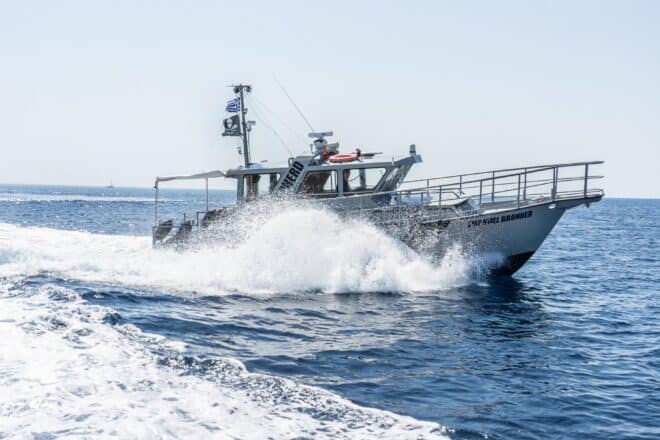
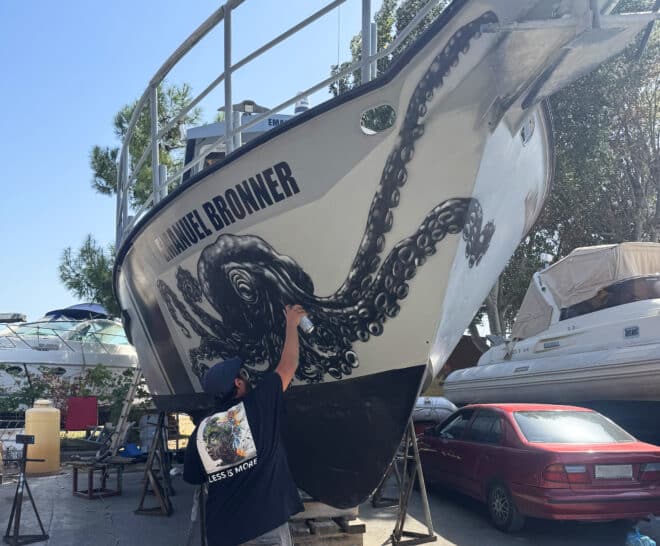
The M/V Emanuel Bronner (Bronny as the ship is lovingly called by our Greek director Valia) has been stationed in the Alonnisos National Marine Park where our crew is working with the Greek coastguard and local park authorities to protect the largest marine park in the Mediterranean Sea against illegal fishing and habitat destruction. This marine park is of crucial importance for the local population of monk seals, whose numbers were critically endangered for decades. In recent years their numbers have increased due to the conservation efforts of the Greek government and all the organizations working to protect this beautiful area. We have a very small but extremely dedicated crew that patrols the marine park with the Emanuel Bronner and all illegal activity is reported to the authorities. This has resulted in several arrest and hefty fines, being a strong deterrent against illegal fishing. The Alonnisos National Marine Park is one of the most beautiful areas I have ever seen and I’m proud to protect it with Dr. Bronner’s.
Tell us about the plans for this year’s campaign using the M/V Emanuel Bronner.
This year we will be doing something extra with the M/V Emanuel Bronner. Even though our work in Alonnisos continues, we will be taking the ship north to the Greek mainland coast. Here our crew will work together with the crew of our other vessel, the M/V Sea Eagle in what we hope will be the biggest confiscation of illegal octopus traps in history. For almost three months we will be looking for these illegal traps and remove them from Greek waters. Due to the immense volume of traps, we have to team up with a large vessel as storage capacity on the M/V Emanuel Bronner isn’t sufficient. So, the M/V Emanuel Bronner will be doing the scouting missions, finding and marking the traps. The M/V Sea Eagle crew will then spend every day pulling in traps and freeing octopuses. Our old record for confiscated traps was set three years ago in the Tuscan Reserve with more than 7,600 traps confiscated and hundreds of octopuses saved. This year we intend to crush those numbers. Octopus populations are under a lot of pressure from extensive and illegal fishing, and their role in the ecosystem is crucial. For instance, the monk seal feeds primarily on octopus. It’s all connected.
What was the impact of the work the M/V Emanuel Bronner was used for in the Baltic Sea, and is that work being continued with a new vessel?
The M/V Emanuel Bronner was elemental in the beginning of our campaign in the Baltic Sea. The ship really got us started with this important work. Every year, porpoises and other wildlife get trapped in gill nets and drown. Our team of experienced divers goes down into the murky and cold waters of the Baltic Sea to recover these nets before more animals get killed. This campaign grew so much that we needed a larger vessel to accommodate the divers and equipment needed to do this work safely. The new vessel, the M/V Triton, was purchased by Sea Shepherd Germany with funds that were raised off the success of the Baltic Sea campaign. If it hadn’t been for Dr. Bronner’s, we would have never been able to expand this campaign now covering Germany, Denmark and Sweden.
What else is Sea Shepherd up to these days? Give us a sense of the scope of your global work in 2025.
I just came back from our third Antarctic krill campaign, this was the first time in 13 years that I joined a trip down to the Antarctic. I was shocked by what I saw, krill fishermen competing directly with the whales for their primary food source. I was equally shocked by the general lack of sea ice, no doubt the warmest I have ever seen Antarctica in March. But we were also treated with an amazing spectacle when one morning we saw a pod of over 500 whales all around our vessel. I have never seen so many whales at once and it made us more determined than ever to stop this destructive fishery.
Our work in Mediterranean continues as does our work in Africa and the Baltic and we will be doing our first mission in Bougainville, the newest country in the world that hopes to reach their independence in the next two years. Sea Shepherd is proud to stand shoulder to shoulder with the people of Bougainville to protect their waters from illegal fishing while becoming an official nation.
In Australia we are working with the National Park Services to protect the Australian Sea lion, the only endemic pinniped in Australian waters.
We have a team active in the Faroe Islands to document the slaughter of pilot whales. It is important to continue applying pressure for these atrocities to stop.
And of course our campaign in Greece with the M/V Sea Eagle and the M/V Emanuel Bronner.
As an activist and Sea Shepherd leader of many years, what’s your advice for other activists who wish to sustain their work and dedication over time? How do you stay committed and driven?
You have to find a balance. If you just focus on the negative, it will drain you. I will always balance the negative with the positive. Like with the krill fishing industry as I described above, or with our octopus campaign. It’s heart breaking to see so many traps scattered all over the ocean floor. But then, when you get to free an octopus, it’s a life changing experience. They are so intelligent and simply beautiful.
What’s most important to you about Sea Shepherd’s partnership with Dr. Bronner’s?
There are many things I am proud of when it comes to our partnership with Dr. Bronner’s. First of all, the way Dr. Bronner’s works, it’s an example to companies worldwide. The world would be a much better place if all companies share their ethics and profit sharing. I am also proud that we are working for such a long time together. It’s a true partnership – Dr. Bronner’s is with us on the waves wherever we go. And of course, last but not least, the Dr. Bronner’s products are amazing. We use them on our ships, I use them at home – simply the best.
Finally, what is your favorite scent of Dr. Bronner’s soap?
Ah, that’s the easiest question of all, always peppermint.
But why limit my choice to the scents, the Magic Balm is amazing for all muscle sores and I cook with the coconut oil in many of my recipes.
Thank you for your time, Alex, and most importantly, for all the amazing work you and Sea Shepherd staff do to protect our world’s oceans!
Sea Shepherd also shared this heartfelt thank you message to Dr. Bronner’s from the Director of Sea Shepherd Greece, Valia Stefanoudaki:
Want to learn more? Check out Sea Shepherd Global.